Showing posts with label dogs. Show all posts

Monday, 18 January 2021

Faceplanting in molehills (Moncreiffe hill)


When I said that people feel perfectly entitled to regularly tell dog owners what to do it is no exaggeration. I wrote the piece about dogs only yesterday and along came an example, bang on cue. 

Upon Moncreiffe hill, a sturdy man rounded a corner.  He was kitted out in traditional country clothes and wielded a staff nearly as big as himself .   I, poleless, had just puffed my way up the steep southwesterly corner from where the path runs closest to the motorway.  It then rises in an easterly curve, doubling back on itself towards the lower hillfort, Moncreiffe (185m).


Path, south west corner

  I am usually alert to who might be coming along a path, partly for my own safety, mostly to ensure the dog is leashed early to save whoever is coming from getting a fright in case he barks, something he does quite often to strangers, especially men.  That is one of the reasons I take him into the less populated countryside.  But on this occasion the man appeared suddenly and I was catching my breath, head down as I trudged along the path.  I called the dog back.  Invariably I apologise to people about the barking and explain he is just very noisy.  Most seem fine.   Many understand rescue dogs and are sympathetic.  Some are even kind & will share biscuits, make friends and demonstrate not all the world's a threat.  Moreoever, I have found the dog to be a magnificent judge of character.  Still, while he is not big some do find him frightening.  It is actually he, traumatised by people and a fraction of their size who has far more reason to be afraid, but, being admirably, no coward, he will stand his ground and bark a warning.  

I had no opportunity to apologise to the chap with the big stick.  He told me in no uncertain terms I should keep the dog tethered.  Despite decades of experience, my usual response when confronted is shock.  With the ghost of a presence of mind usually lacking I countered that actually, I hadn't seen anyone in forty five minutes.  But he disagreed, grunted and dissatisfied and unswayed went his own way. 

I had actually been walking one of the steeper, smaller, less well trodden tracks.  As it turned out, in 90 minutes or 4.5 miles I was to see only this man and one couple near the car park.  The forest is large with few people compared to its size, particularly in winter as potholed routes to steep, icy car parks dissuade.  

Typical track in Moncreiffe forest

 Why do people do this?  I don't waylay joggers and tell them to keep their heavy breathing and spittle to themselves.  I don't stop the occasional family or group taking up the whole path and ask them for some space. I don't harangue the odd over-enthusiastic cyclist who bombs out on to a walking path where I am with my frail and elderly parents.  I get shocks and scares from all of these things but I don't accost the culprits.  I don't think most people do, so why do some become so officious and entitled over dogs?  Were I a man with a big stick I would not start giving a woman alone in a forest a piece of my mind.   

When people say what Perthites are known for compared to other cities:  self-righteousness; looking down on people, sniffiness, disapproval, is this what they mean?   I am reasonably immune to stares and dirty looks and have trained myself to not even notice them, yet still remember with astonishment those I used to get twelve or thirteen years simply for using a  donated bike trailer for transporting my kids to nursery along Tay Street.  What new-fangled idea is that? What does she think she's doing? Later, despite having got used to Perth's extraordinary whiteness I remember being horrified and yet not altogether surprised upon being told that there were racist remarks going around some parents in the playground about other parents from a different country.

I lived in London for five years, in Paris, in Edinburgh and generally in much more crowded places where tolerance is a necessity because of the greater diversity of the population.   But there are many places unused to diversity, moreover, habituated to a hierarachy and pecking order, where some people and indeed their families, may have been somewhere near the top for decades. Neither town, council, nor rural society is immune to getting used to privilege, bossing people about and disliking being answered back.  It is a huge fallacy that this is just an English thing.    

This man may have had a momentary scare from a barking dog of small to medium stature, for which I am deeply sorry, but does that mean one can go about making unreasonable demands that dogs should be permanently tethered in empty forests? And actually how often are men scared, walking?  As a female who usually walks alone I am always scared.  Not just of falls or getting lost, which applies to either sex, but of nutters who attack women. Just because I am female I have been terrified at worst, nervous at best, all my life of walking alone  - in the country, in cities and especially at night.  Luckily, I am six foot tall, sturdily built and reasonably fit.  I am delighted to also now have a very protective dog and sometimes poles and other accoutrements but the fact that I am aware of things I might have to hand to defend myself is indicative that I, like many women often do feel worried simply walking.

They shake you up, these encounters.  I console myself not with shouting back but later with fantasies of a post-apocalyptic Scotland in which free-roaming wolf-dog crosses have inherited the character assessment abilities of dogs like mine and tear the officious and judgemental apart leaving bloody trails and mangled body parts in the snow...

Engaged in such reveries, as I descended Moncreiffe fort I slipped on some ice, turned in mid air at the kind of angle I dreamt of as an eight-year-old wannabe gymnast and faceplanted into a molehill, luckily fresh.  I heard from childhood my father's voice,  amused, mocking: "God, punishing".  I ignored it as I spat out earth, rubbed soil out of my eye and salvaged my specs.  And who was there as I tested my limbs for breaks and sprains on top of the hill with an hour left of light?  A well-meaning knight holding out his staff at a safe two metre distance to let me haul myself up?  No.  But there was my hound rushing back to see what had happened; licking mud off my face, performing a dance more often seen at dinnertime and expressing an optimism and concern which, translated, impossibly into speech might have said:  "Are you OK? It's fine, you'll be fine, I'm here, and I can't help at all in any practical way whatsoever but I'm with you", the general effect being: who better, for moral support?  

In practice, carry spare specs. 


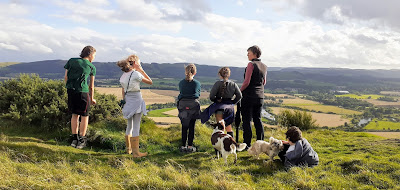
View over Bridge of Earn


Sunday, 17 January 2021

Dogs and the countryside


I was provoked to write this after two incidents near a local farm a few days ago.  I don't want to single out this farm.  The things that happened here might have happened at any farm but they are illustrative of some of the issues regularly faced even by responsible walkers.  

When we are in the countryside, there are often notices about dogs.  Dogs must be kept on a lead (even in places where it makes no sense).  Dogs kill sheep.  Farmers will shoot your dog.  They are threatening and intimidating.  As a reminder I often hear shooting at close quarters around farms and estates.  I am usually alone and always find it alarming.  It is also depressing.  Not content with growing animals for slaughter, some of these people like to kill the wild things too. This is also sold to punters under the bluster of huntin' and fishin':  healthy, outdoor pursuits for Real Men.   The signs are designed to frighten and deter people from taking a dog out and if you insist then to never have it off the lead.

Most Ramblers groups won't accept dogs because the dog might chase livestock, they get under peoples' feet, some people don't like dogs etc. I feel lucky that I had support from Rambler's HQ and my own group who made an exception for my dog.  Ramblers Scotland then wrote an excellent piece in support of dogs on walks called  "A template for running dog -friendly walks".  Inspired by Jenny Mason of North Hertfordshire who runs a successful Ramblers group that welcomes dogs it was about the positives of walking with dogs and the actual lack of problems. Unfortunately, I can't find that it's been published online.   

Over the years I have noticed how few dogs I now see off the lead even in remote countryside. This does not necessarily mean there is a rise in responsible dog ownership.  It could equally mean people feel more intimidated and tether their dogs at all times to avoid any potential bother of being accused of poor dog management.  It now seems expected.  Perhaps it is due to a rise in rules in our overcrowded society and our extraordinary habit and inclination as a nation of unquestioningly obeying rules, or just the perception of a rule, no matter who imposes them or how sensible or even legal they are.  With rules comes suspicion of anyone who thinks about or questions things imposed upon them. 

 Around an eastern entrance / exit to Deuchny wood the track is plastered with these signs.  Although the track was well fenced and the farm distant I still felt the pressure to leash the dog.  I always do as we approach farms.  There are often free range chickens around, open doors into kitchens, there may be food on bird tables or other dog temptations.  It was lucky I did because there effectively was no fence around the sheep field.  


And this is my point.  Should farmers be threatening to shoot dogs and plaster signs everywhere insisting on leads in unreasonable places?  Or should they be properly fencing the products they fatten for slaughter while they continue the intensive, chemical-ridden, unsustainable practices that poison and exploit the land and our bodies and endanger our planet? And for what? For money and profit.   

Despite all this, should farmers have our sympathy?  Are they, in Perthshire, barely scratching out a precarious living?  I don't know but I doubt it because the farms I see are invariably fat, rich, privileged and luxurious: large, immaculate houses worth hundreds of thousands, perhaps millions of pounds, with ponies in paddocks and huge, expensive cars and trucks.  Some have extra businesses like rental properties or bed and breakfast on the side.     They enjoy all this with splendid isolation, fine views and none of the attempted persecution they support of walkers through advertising the "We will shoot your dog" campaigns run by e.g. "Farmer's Guardian" magazine, whose creepy name has more than a hint of authoritarianism about it. 

We got a whiff of that farmyard smell.  It was Hill of Errol all over again where the dog refused to go round the outside of the farmyard and ran away, terrified, back the way we had come.  I had spent at least fifteen minutes coaxing, collaring and eventually carrying him up the slope past a barnfull of....bulls?  Cows?  Pigs?  No, just big fluffy sheep.  So I always wonder what that farmyard smell means to dogs.  It seems likely mine is just afraid of the animals there though I can't help wonder if the animals corralled in barns let off some smell of fear or misery to which some dogs react.  This rescue dog is, after all, afraid of just about everything:  all livestock including horses, also trains, traffic, trucks, machinery, bikes and many people. It is his sometime treatment by people that seems to have traumatised him.  

So again he pulled away back towards the wood and when I insisted on moving on, shook, bucked and eventually wriggled out of his collar and was off back the way we had come.  He stopped and stood waiting for me. Again, I cajoled and caught him with treats and carried him, a heavy, squirming, muddy, unwieldy, frightened armful, past view of the sheep after which his fear disappeared and he walked beside me.  We passed the house and reached the road junction.  I turned right towards the western side of Deuchny hill but things looked different in the snow and I soon realised I seemed to be heading towards another farm building instead of being on the road I had expected.  As I checked the map two well built, fierce farm collies tore out of the farmyard and down the track towards us, barking and snapping. My dog flattened his ears, looking fearful then bucked his way out of the collar again.  Without touching the dogs I kept our attackers at bay with the walking poles for which I was thankful.  Mine stood looking awkward, then started a sort of hurried, sidelong trot away through the farmyard. I thought of all the dog temptations there then saw another open field and wondered if this was the day I was going to discover he was a bizarrely fearful sheep-chaser.  I waited for the bang of the terminal shot as I hurried after him.  But oh the relief.  There he was, standing at a safe distance, simply waiting for me as usual on the other side of the farmyard away from the vicious dogs.  Again, there was no getting him back through the yard but there was no other choice.  Once more I heaved him up into my arms and carried him through in two goes.  Someone had obviously thought better of their animals attacking walkers because while I saw and heard no-one, the collies did not reappear. 

The path for walkers in Scotland is still far from easy.  Despite the Land Reform Act many farms, estates and private households still 

- block land access 

- fail to keep their animals properly fenced

-  intimidate walkers, especially walkers with dogs, with signs and loose, aggressive animals and try to normalise the idea that the only dogs that should be off the lead in the countryside are farm dogs.  

Additionally, many stiles and cattle grids are impassable to dogs. 

 Landowners, some of whom have held land for centuries, still easily have the upper hand.  

I end though with a different example.  Sheep often wonder on Kirkton hill, south of Perth.  However, the local farmer has created a good alternative route to this hill avoiding livestock and signposted it. The path though rough, rocky and muddy is now well-walked.  It has also been planted with young native trees and affords excellent views over the ox-bow lake on the Earn. 

Kirkton hill

So while most farmers still make exploitative, inefficient use of the land by farming animals and some will do anything to stop you setting foot on "their" land, some are better than others.